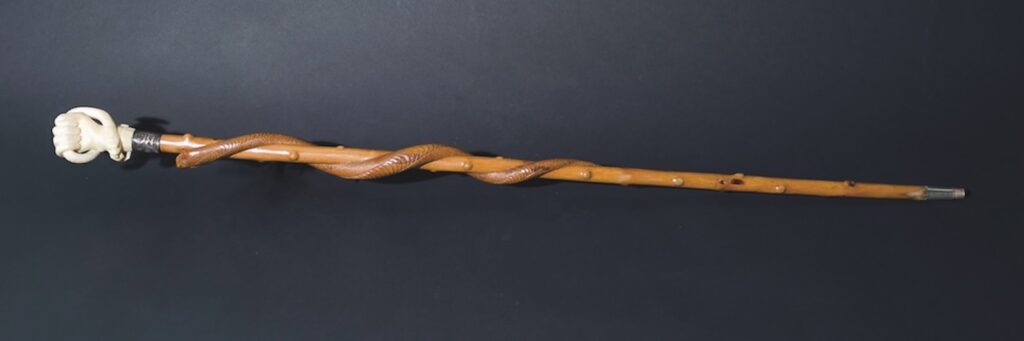
Four decades ago, I found myself in the Jefferson County Museum of Art + History in Port Townsend, Washington, standing in front of the cane pictured above. I learned of its existence from a book called Winter Brothers by Ivan Doig. The book was a biography about pioneer/historian James Swan, who at the age of 65 in 1883 made a journey to the Haida Gwaii at the behest of the Smithsonian Institution. There he met Chief Edinsa/Albert Edward Edenshaw and purchased two beautifully carved canes from his artistic nephew, Tahayghen/Charles Edenshaw. The cane I viewed was one of them.
As my life and career as a marine biologist progressed, I thought about the cane from time to time, remembering the dynamic art it embodied, and I wondered about the person who created it and where and how he lived. I didn’t know it back then, but the seed of an idea had been planted that eventually led to my own journey of discovery to the Haida Gwaii during the summer of 2024 at the age of 67, two years older than Swan. I’m retired now and spend some of my free time writing science articles that I hope will motivate young people to consider a career in science and technology. My initial idea for the Haida Gwaii journey was to write about the marine life I encountered in “Canada’s Galapagos.” However, I soon realized it would be impossible to describe the ecology of the Haida Gwaii without including its people and their connection to the sea, sky, land, and supernatural beings that live there still.
And so began the new goal of learning all I could about the Haida and telling the story of their beginnings, the injustices they suffered that nearly wiped them out, and the way they were able to regain their culture and ultimately government recognition of aboriginal sovereignty over the Haida Gwaii – a responsibility they had never relinquished. This story of the Haida was both inspiring and humbling, and was one of the most challenging things I have ever attempted — and by far the most rewarding. Although I spent a year researching and writing, I feel as though I only scratched the surface of a compelling and complex people who have lived in a remote archipelago for at least twelve millennia, making them one of the oldest cultures on Earth. I also came to understand that the cane I viewed forty years ago was actually a message from my younger to older self, reminding me never to forget what the Haida have always known: that everything is connected to and depends on everything else.
My story of the Haida is presented in three parts:
Part 1: Beginnings describes the vibrant culture that began with the arrival of the first peoples to the Haida Gwaii approximately 12,000 years ago. This part of the story describes the world they created: how the Haida organized and governed themselves, their relationship with the natural world around them, the myths and oral stories they used to document their history, and the vibrant and complicated art they created from the natural materials available to them. Over millennia, they created a complex culture that used art, dance and songs to record and celebrate their history.
Part 2: Contact explains how the Haida culture was dramatically changed and nearly destroyed, beginning with the first documented contact with Spanish fur traders in 1787. The arrival of the “Iron Men” in large sailing ships and those that followed impacted the Haida in a way that still reverberates through their society 250 years later.
Part 3: Renewal describes the long road the Haida traveled to indigenous sovereignty that was fueled by continued injustice at the hands of the Canadian government. This part of the story describes the Haida code of ethics and values that promotes respect for each other and all living things and adheres to the concept that everything is connected to and depends on everything else. These ethics and values instill pride in their culture and provide a path forward for their people to live harmoniously in the three worlds of past, present, and future.
I am profoundly grateful to the Council of the Haida Nation for granting me permission to write this story, and for the kindness and willingness of the Haida people to share their stories with my wife and I during our visit. It was a remarkable experience that we will never forget.
0 Comments