The dawn of the 20th century brought new changes and challenges to the people of the Haida Gwaii. The efforts of Dawson, Swan, Swanton, Franz Boaz and others increased the visibility of the Haida to the outside world, attracting the attention of a new group of Takers that took advantage of a population still struggling to move beyond the effects of smallpox and the actions of church and state.
Unfortunately, the two new examples of taking described below were very similar to what happened before: another round of family separations in the 1960s that exiled the Haida children far from home, and the selling of tree farm licenses by the Canadian government that allowed large mainland corporations to harvest timber on Haida Gwaii without Haida input, permission, or revenue sharing. These and other events served to mobilize the Haida to demand the Canadian government recognize the aboriginal sovereignty over the Haida Gwaii they had never relinquished. The Haida court claim filed by the Council of the Haida Nation and its Hereditary Chiefs Council in 2002 summarized their position with a simple declaration:
We are not asking you to give us aboriginal title.
We believe we have always owned it.
We are merely asking you to recognize that fact.
The Sixties Scoop: Residential Schools Revisited
I sometimes wonder if the Haida and other indigenous people living in Canada during the second half of the 20th century believed that positive changes might be on the horizon. In 1951, the restrictions imposed on them from the 1885 amendments to the Indian Act finally ended. During those 66 years, taking part in religious ceremonies, dances, or any form of public cultural exhibition was a misdemeanor punishable by two to six months in jail. Less than a decade later, in 1960, indigenous people in Canada gained the right to vote without giving up treaty rights, though it must be noted that nonnative women had been allowed to vote since 1918, and Asian Canadians had been granted voting rights since 1948. And while natural resource extraction in the Haida Gwaii from mainland corporations was increasing during the 1960s, the “timber wars” were still about 20 years away.
Then came the Sixties Scoop.
As it turned out, the amendments to the Indian Act made in 1951 that allowed indigenous people to publicly celebrate their culture also gave the provincial government authority over indigenous child welfare. This authority allowed the government to forcibly remove indigenous children from their families and send them far away from home to an uncertain future without having to seek the consent of indigenous communities.
The residential school system, which had declined in the first half of 1900, was back again with a different name but the same goal. The Canadian government called it cultural assimilation; the rest of the world recognized it by a more accurate term: cultural genocide.
As described in The Sixties Scoop written by the Indigenous Foundation, it is true that the number of indigenous children in the Canadian child welfare system in some provinces was over 50 times higher than it had been in the early 1950s. It’s also true that indigenous communities that were still recovering from the effects of the residential schools faced high poverty rates and significant socioeconomic challenges. Regardless, the decision of the government to remove the children from their homes and place them with white guardians was an extreme measure that inflicted further damage on the Haida people by creating a new generation of adults who never found their way home or felt lost and disconnected if they did.
During our trip to the Haida Gwaii, we met a young Haida woman who talked to us about the effects of the residential schools and Sixties Scoop on her extended family. Although she was not born during that time, her grandparents, parents, aunts, and uncles were. She told us they carried a sadness and sense of loss they seldom discussed but that always seemed present, especially if a local child went missing. The young woman spoke of participating in therapy sessions with community members who had only recently begun to share their stories. Generational damage was still very real and unresolved; however, progress was being made by both survivors and their families by acknowledging the trauma but choosing not to dwell in it – instead, helping one another in choosing to move forward.
Enough is Enough: Logging and Habitat Destruction
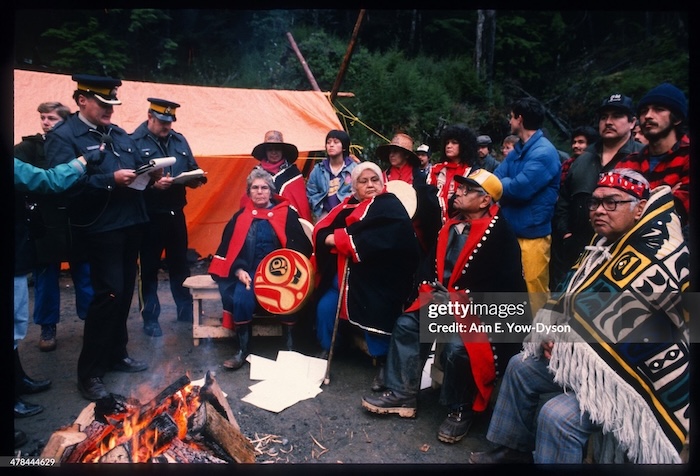
Officers of the Royal Canadian Mounted Police (RCMP) deliver an injunction to Haida demonstrators during a protest over logging on South Moresby Island, Queen Charlotte Islands, British Columbia, Canada, November 1985. Photo Credit Ann E. Yow-Dyson, Getty Images
In the early 1900s, the old growth timber on the Haida Gwaii attracted the attention of mainland logging companies who found the red and yellow cedar, Western hemlock, and Sitka spruce irresistible. Tree harvests began slowly but accelerated as time went on, replacing sea otter pelts and gold as the new commodity sought by the Takers. Working under the assumption that the 500-600 survivors of smallpox left on Haida Gwaii were not really a sovereign nation, the Canadian government sold their resources to the highest bidder and shared in the profits. Tree farm leases were awarded to large mainland companies like Weyerhaeuser, Bloedel, Rayonier, Brascan, and Western Forest Products without any Haida input. Although the timber companies made billions of dollars between 1979 and 2004, none of the revenues were shared with the islanders.
One of the first major clear cuts occurred in the 1970s on Talunkwan Island off the eastern shore of Moresby Island. Later dubbed “the worst environmental horror show in British Columbia,” the results of the logging left the land scarred and destabilized; during heavy rain events, mudslides were common. The next tree farm lease occurred in 1978 when the government awarded harvest rights to Rayonier on Lyell Island/Athlii Gwaii. The resulting destruction of the land and disturbance of sacred sites triggered a “War in the Woods” in 1985 that resulted in the blockage of logging roads and the arrest of 72 Haida elders who arrived to protest the action in their traditional clothing. Two other notable events occurred in 1985: the creation of an ad-hoc group of Haida and environmentalists called the Island Protection Society, and the publication of a coffee table book called Islands at the Edge: Preserving the Queen Charlotte Islands Wilderness, which included a forward by Jacques Cousteau. The book caught the attention of the world.
Some good news occurred in 1988, when Canada and the Haida Gwaii agreed in principle to create the South Moresby National Park Reserve and name it Gwaii Haanas, but the Canadian government continued to issue tree farm licenses without Haida input or approval, despite court rulings favorable to the Haida. In 2004, the Haida Land Use Vision addressed important cultural, economic and environmental attributes that needed to be protected for future generations. This foundational document was used during subsequent discussions related to land-use planning with the Canadian government.
Then in 2005, when a new tree farm license transfer by Weyerhaeuser occurred without Haida input or government intervention to stop it, the road barricades went back up with the Haida elders again leading the way in a protest called “Islands’ Spirit Rising,” which resulted in a book of the same title, published in 2015. Some of the elders, in their 90s and veterans of the 1985 blockade were arrested and sentenced to 4 to 6 months in jail. Cooler heads prevailed in court, and no jail time was served. The presence of the elders helped change public perception about logging on the Haida Gwaii and created powerful new alliances to support their cause. As noted in The Haida Gwaii Lesson: A Strategic Playbook for Indigenous Sovereignty:
“Under the name BC Coalition for Sustainable Forest Solutions, no fewer than forty-nine NGOs representing labor unions, 23 churches, and environmental organizations, openly supported the blockade, while a provincial poll indicated that three of five BC citizens wanted their province to negotiate native land claims. Moreover, the vast majority of people on the islands, including the non-Haida, supported Islands’ Spirit Rising.”
Meanwhile, the battle for aboriginal sovereignty continued.
The Long Road to Indigenous Sovereignty
“According to the UN, there are 370 million self-described “indigenous peoples” alive today. Generally defined as people whose community preexisted a larger nation-state that enveloped them, indigenous peoples comprise about 4,500 distinct cultures and speak as many different languages and dialects. While making up only 5 percent of the world’s total population, they occupy about 20 percent of the planet’s land surface. They exist within and straddle the borders of 75 of the United Nations’ 193 recognized countries… They are stewards of about 80 percent of the world’s remaining biological diversity and account for 90 percent of its cultural diversity.”
~The Haida Gwaii Lesson, A Strategic Playbook for Indigenous Sovereignty.
Although the Haida’s drive for sovereignty increased in the 1900s, the dialog concerning what constituted a first versus second nation began hundreds of years earlier with the arrival of the Spanish and English in the late 1700s. As noted in Part 2 of this story, the events that occurred after contact were sanctioned by a papal decree signed in 1493 called the “Doctrine of Discovery,” which stated that if a Christian explorer encountered a new land occupied by non-Christian people, the explorer could claim it for his church and country. The ideas in the Doctrine seemed nonsensical to the Haida, given they had lived and thrived on the Haida Gwaii for thousands of years. The people who stepped ashore in 1744 obviously did not share these beliefs.
An excellent account of the history and outcomes related to Haida sovereignty can be found in The Haida Gwaii Lesson mentioned above. This book chronicles both the successes and failures the Haida encountered in their dealings with British and Canadian governments, which began soon after contact and that continue to present day. Unfortunately, the story of the Haida is common amongst indigenous people throughout the world who struggle to break through the effects of colonialism in its many forms and to assert the rights they have never agreed to relinquish.
For the Haida, the way forward involved endless court cases filled with success and setbacks. Multiple attempts to assert tribal sovereignty were summarily rejected by the Canadian government for a variety of reasons, including the belief that the post-smallpox population of 500 people did not constitute a real nation, doubts about how long the Haida had actually lived on the islands given there was no written record of their history, and the usual arguments paraphrasing the Doctrine.
A breakthrough of sorts occurred in 1993 with the Gwaii Hanas Agreement that established co-management of Gwaii Hanas National Park Preserve by the Haida and Canadian government. In 1997, a significant British Columbia Supreme Court ruling in the Delgamuukw Case stated aboriginal title to the Haida Gwaii had never been extinguished, and noted that a judge in a previous case had erred by not accepting the oral history as evidence of an aboriginal connection to the land. In essence, the old stories told to John Swanson by Ghandl and Skaay had reappeared, resonating this time within the walls of a courtroom rather than during a potlatch gathering.
But the Haida’s adversaries had underestimated them, for instead of discouragement, the Haida demonstrated a strong determination to achieve their goal and the patience required to play the “long game” rather than expect a quick resolution to the dispute. Despite the setbacks, the Haida pushed forward, creating the Council of the Haida Nation in 1974 to speak with one voice that proclaimed they were the “rightful heir and owner of Haida Gwaii.”
As time went on, the Haida continued to organize themselves for the long battle ahead, establishing a constitution in 2003, a Land-Use Vision in 2004, and a Giving the Name Back with Respect ceremony in Old Massett in 2010 when the colonial “Queen Charlotte” name for the islands was politely returned to the Crown and Haida Gwaii, the true name, was formally recognized by the government of British Columbia. In the last five years, a series of agreements between the Haida and the Canadian government paved the way for the final affirmation of aboriginal title in 2025, as shown below:
In 2021, the GayGahlda/Kwah hiahl dayaa “Changing Tide” Framework for Reconciliation agreement between the Haida Nation and the British Columbia and Canadian governments created an incremental approach to negotiating reconciliation agreements,
In 2023, the Nang K’uula/Nang K’uulaas Recognition Agreement recognized “the Haida Nation’s inherent rights to governance and self determination,”
In 2024, the Gaayhllxid/Giihlagalgand “Rising Tide” Haida Title Lands Agreement resulted in British Columbia formally recognizing Haida ownership (aboriginal title) of the Haida Gwaii. It was the first time in Canadian history that a colonial government had recognized indigenous title across an entire terrestrial territory outside of the courts,
In 2025, the Chiixuujin/Chaaw Kaawgaa “Big Tide (Low Water) Agreement with Canada further affirmed Haida aboriginal title to the land and water resources of the Haida Gwaii.
Finally.
The Path Forward: Living in Three Worlds
Now that the Haida have finally achieved aboriginal sovereignty, what is next in their journey, and how exactly will they live in the three worlds of past, present, and future? Perhaps the roadmap can be found in the list of Haida Ethics and Values that appear in the Haida Gwaii Marine Plan of 2015:
Yahguudang: Respect – for each other and all living things
‘Laa guu ga kanhllns – Responsibility – to manage and care for our sea and land
Gina ‘waadluxan gud ad kwaagiida – Interconnectedness – Everything depends on everything else
Giid tll’juus. Balance – the world is as sharp as the edge of a knife; balance is needed in our interactions with the natural world
Gina k’aadang.nga gii uu tl’ k’anguudang – Seeking Wise Counsel – from elders to teach us about traditional ways and how to work in harmony.
Isda ad diigii isda – Giving and Receiving – giving thanks to the natural world for the gifts that we receive.
During our visit to the Haida Gwaii, we saw many examples of these ethics and values in practice.
For instance, a visitor may notice a Haida-operated logging operation next to an older nearshore site that is being restored. Similar restoration and protective actions are occurring at the sites of ancient villages where Haida-supervised archaeological digs occur in the summer. There were notices of public meetings to discuss options for replacing the existing diesel-generated electricity with cleaner renewable options. Language immersion classes are offered to reconnect younger and older people to their culture, though our Rose Spit Haida guide did comment that “Haida is hard!” The Haida are working with museums and universities to retrieve cultural artifacts that were taken without permission and taking on the difficult task of identifying the lost victims of the residential school system to bring closure to families. They are also welcoming people of the world to share and enjoy their culture. Visitors can now experience Haida history at the spectacular Haida Heritage Centre, or go on a guided journey to the ancient villages and learn about the pre-contact culture from an on-site watchman. There is even an annual summer concert event called the “Edge of the World Music Festival” that attracts an international crowd.
As we drove around the Haida Gwaii, the art, stories, and history seemed to be everywhere. These were the things that carried the people through the toughest of times and continue to serve as a link between the past and the future. Young Haida artists who grew up studying the art of Charles Edenshaw, Bill Reid, Robert Davidson, and other masters are now carrying on the tradition, making bold creative leaps and taking the extraordinary art to new levels. New totem poles have been erected to replace the ones that were destroyed, and stand tall in testament to proud Haida traditions. And on August 24, 2024, the day after we arrived, the 51-foot Tluuwee Kwiiyaas, “the beloved canoe,” was carried by dozens of people to the water’s edge at Old Massett to touch the ocean for the first time. She was the first hand-carved canoe in a long time, and although we missed the launch, we heard stories about the potlatch for days after.
Despite the bold moves to embrace the future, echoes of the distant and recent past return whenever a child goes missing or a family member dies from a drug overdose. A poster we saw of a missing young woman was a school friend of a young Haida woman we met. She said it was a daily reminder of the challenges that still exist within her community. Whether it is working through the horrors of the residential schools and the family destruction of the Sixties Scoop, or the ongoing efforts to keep the younger generation engaged in their culture and hopeful for the future, the Haida continue to work toward a greater good that is consistent with their ethics and values.
And the world is taking notice.
The approach the Haida employed to restore their sovereignty is being emulated by other aboriginal societies, and the islands are now visited by young scientists and resource managers eager to learn the Haida approach to sustainable living that can be adapted to challenges they face back home.
As the Haida embark on a new chapter of their journey, they maintain a firm connection to the land, sea, sky, and the spiritual beings who have been with them from the beginning. This connection comes in many forms, as the Haida artist Bill Reid realized when he returned to his ancestral home looking for an identity he had not found in modern western society:
Near the end of Raven’s Cry, a 28-year-old Bill Reid, the great nephew to Charles Edenshaw, tells of a “strange compulsion to carve, to engrave silver, to make bracelets and earrings like those treasured as heirlooms by relatives at Skidegate and Massett.” As he explored the art of the past and eventually left his job as a radio announcer in Toronto to take up his new profession, he felt that his great uncle was there with him, along with ghosts of Haida chieftainesses. As he created a replica of a Haida village for the University of British Columbia, he noted “They watched every move I made…I felt their criticism. I had to do it their way.”
Bill Reid could feel the Haida elders guiding his hand, even though he had spent much of his early life away from the Haida Gwaii. He went on to produce over a thousand original works representing Haida myth, culture, and symbolism. These connections to the past – the renewal of language, art, and traditions – and a culture based on responsibility and respect – continue to inspire the Haida people as they prepare for the next thousand years.
Coda
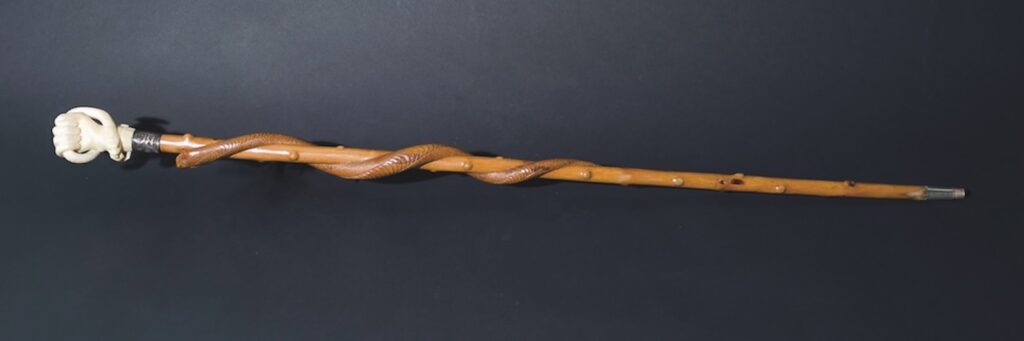
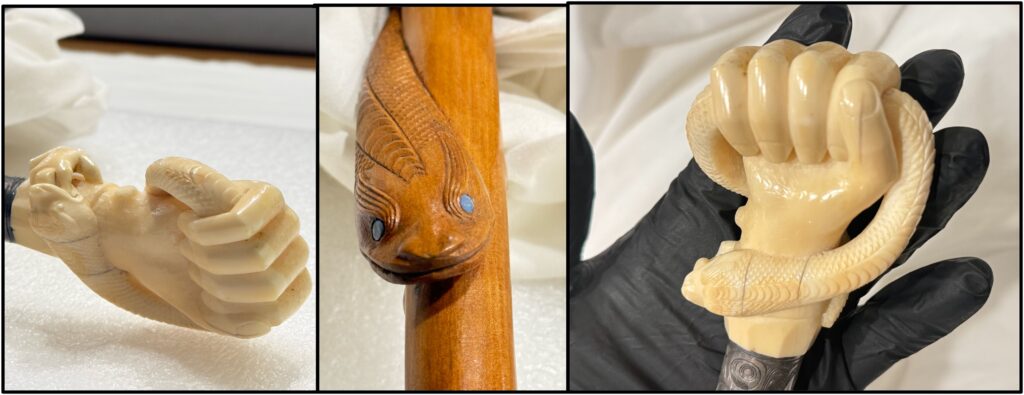
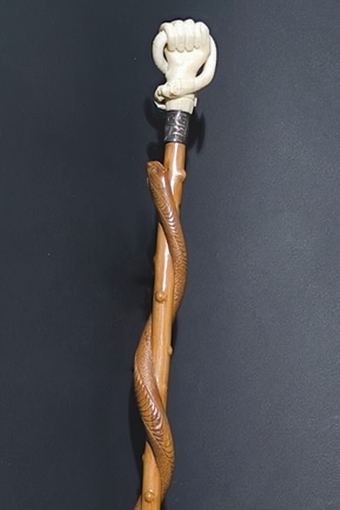
This story eventually ended as it began, with the cane carved by Tahayghen/Charles Edenshaw that James Swan brought back to Port Townsend so long ago. Two canes were purchased: this one remained with Swan until he died, the second is in the Smithsonian Institution. When I published this story in October 2025, the cane was in storage and unavailable for viewing until later this winter. Like my trip to the Haida Gwaii, life had delayed my plan, but this time only for months rather than decades. Thanks to Ellie DiPietro of the Jefferson County Historical Society, I was finally able to see it in late January 2026- this time up close and personal rather than through the glass of a museum case. Ellie was careful with it- look but don’t touch. I followed the rules… reluctantly. Haida art has a way of eliciting strong feelings and a sense of awe, and this was no exception. Charles Edenshaw cane brought the inanimate to life: a snake with green abalone shell eyes curling up a crabapple branch, held firmly by a hand carved from a walrus tusk as the snake attempted to swallow a frog. It shows its age after 143 years but is still an amazing sight, released from its storage box and quietly waiting for me. Have a look:
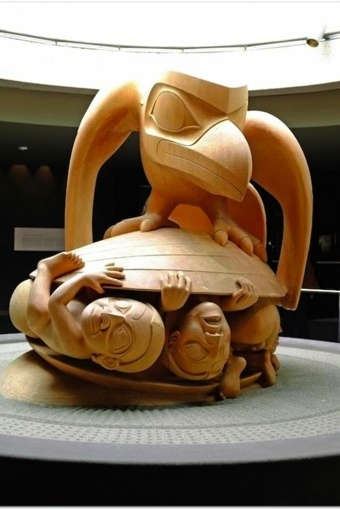
Before that journey, I planned on writing a story about the ecology of the “Canadian Galapagos,” but I soon realized it was impossible to tell a story like that without including the Haida people and their connection to their world. The story didn’t come to me all at once. Instead, it emerged slowly as I read everything I could find about the Haida and thought about the deeper meanings of the trip. Gradually over time, the writing became a reflection of the place I had visited, filled not only with hard truths about the struggles of the Haida, but also with their spirituality, sense of family and place, and ability to embrace nature. Unlike my other science writing articles, this story was set in a world where Raven released the first humans from the clam shell, where people and animals could shape shift and speak to each other, where characters like Ghandl and Skaay could tell a shy, Harvard-educated ethnologist the history of a people that stretched back twelve millennia using poetry rather than prose.
It took me a year to figure all of this out, but it was worth it.
Some people believe that when we are young, we should write a letter to our older selves that reminds us how we viewed the world back then and what we cared about – a letter that helps us remember our hopes and dreams, our unbounded curiosity, and our sense of purpose – the kinds of thoughts that can dim with age if we are not careful. For me, Tahayghen’s cane was my letter to my older self. It beckoned me to glimpse another world beyond my understanding and ultimately set me off on a voyage of personal discovery 1000 miles from home and forty years later.
During my time on the Haida Gwaii, that other world spoke to me in the language of art, stories, dance, and song, and brought me closer to a people who truly understand that everything depends on everything else. And when I returned home, I realized the younger me wanted the older version to remember the natural world is not just a thing to be studied, but a force to be respected. A non-indigenous person like me can never truly understand indigenous culture no matter how hard I try, because my life experiences are profoundly different. What I can do, what we all can do, is learn from their example, and try to be better parts of the whole, no matter who we are or where we live. We are all connected; everything truly does depend on everything else.
My sojourney to the Haida Gwaii brought those ideas back to me.
And for that I am grateful.
Haawa.
Special thanks to Blythe Barbo: my wife, traveling companion, muse, webmaster, technical editor, and best friend.
Information Sources
A Brief History of Federal Voting Rights in Canada, Elections Canada.
‘A Historic Day’, Haida Nation Recognition Act Passed in BC’s Legislative Assembly, Coastal First Nations, Great Bear Initiative,
ANALYSIS: Looking Back: 1985 Logging Blockade on Athlii Gwaii, The Griffinss’ Nest, Jeffrey Chan and Derek Chau, November 8, 2021.
Awakening a Haida Clan that Slept for 150 Years, Odette Auger, Indiginews, Aug 19, 2022.
Bringing the Records of Haida Gwaii’s Children Home, UFV Today, University of the Frasier Valley, September 16, 2024.
British Columbia, Haida Nation Restore Name “Haida Gwaii” To Islands, ISUMA TV.
Canada Marine Protection Plan Aims to Serve as Global Model, RFI, October 16, 2024.
Cane from Port Townsend Collection is Part of Vancouver, B.C., Museum Overview, Peninsula Daily News, January 16, 2014.
Charles Edenshaw – An Historic and Influential Northwest Coast Native Artist, Northwest Native American Art- Past and Present
Charles Edenshaw: The Raven, The Sea Bear and Other Stories, Katherine Stauble, National Gallery of Canada, March 3, 2014.
Chiixuujin Chaaw Kaawgaa “Big Tide (Low Water)” Haida Title Agreement, Mandell Pinder LLP and the Council of the Haida Nation.
Documentary about 1985 Haida Gwaii Blockade Premieres at VIFF, CBC News, October 3, 2024.
Eagle Transforming, The Art of Robert Davidson, Ulli Stelzer and Robert Davidson, Douglas & McIntyre, Vancouver/Toronto, University of Washington Press, Seattle1994.
Everything is Connected: Supporting Indigenous Climate Resilience in a PICS Summer Internship, Pacific Institute for Climate Solutions at the University of Victoria, December 11, 2024.
GAAYHLLXID • GÍIHLAGALGANG “Rising Tide” Haida Tidal Lands Agreement Between the Haida Nation and British Columbia, Council of the Haida Nation, March 27, 2024.
GayGahlda “Changing Tide” Framework for Reconciliation, Council of the Haida Nation, August 13, 2021.
Gaw Tlagée Xaad Kil, Council of the Haida Nation.
Gina ‘waadluux̱an gud kwaagid. Everything Depends on Everything Else, Haida Gwaii Museum, January 15, 2015.
Haida Artist Tamara Bell Installs 215 Shoes on the Steps of Vancouver Art Gallery as a Memorial to Indigenous Children Who Died at Residential School, Hadani Ditmars, The Art Newspaper, 4 June 2021.
Haida Constitution, Council of the Haida Nation.
Haida Ethics and Values, CHN Marine Planning.
Haida Gwaii Community Moves to Restore Indigenous Name- Village of Queen Charlotte to be Renamed Daajing Giids,Coiurtney Dixon, CBC News, May 17, 2022.
Haida Narratives: Reclaiming Remains, Stories, and Artifacts from a Living Culture, Giselle Paquette, Journal of Integrated Studies, Vol. 15 No. 1 (2024).
Haida Open Seattle Front in Forest Fight, By Paul Shukovsky, Seattle Post Intelligencer, April 19. 2005.
Hereditary Chiefs Council, Council of the Haida Nation.
Human Greed Clear Cut Raped Talunkwan: “The Worst Environmental Horror Show in British Columbia.” A Beautiful Haunting Read on Ancient Trees, Dendrochronology by Robert Moor, Emergence Magazine, Nov 14, 2024.
Iljuwas Bill Reid, Life and Work, Gerald McMaster, Art Canada Institute.
Indian Act, The Canadian Encyclopedia.
Indian Act and the Right to Vote, Indigenous Corporate Training, Inc., February 12, 2025.
Islands at the Edge, Preserving the Queen Charlotte Islands Wilderness, Island Protection Society, Douglas and McIntyre, Vancouver/Toronto, University of Washington, Seattle and London, Internet Archive, 1984.
Islands’ Spirit Rising, Reclaiming the Forests of Haida Gwaii, Louise Takeda, University of British Columbia Press, 2015.
Lost Generations, Open Library.
Missing And Murdered Indigenous Women and Relatives (MMIWR), National Indigenous Women’s Resource Center.
Nang K’uula • N a n g K’úulaas “Recognition Agreement,” Council of the Haida Nation, April 4, 2023.
National Day of Awareness for Missing and Murdered Indigenous Women and Girls, First Nations Health Authority, May 5, 2023.
Province Announces Historic Decision to Restore Ancestral Name in Haida Gwaii, Kaitlyn Bailey, the Northern View, July 13, 2022.
Provincial Agreement on Haida Aboriginal Title, British Columbia, February 19, 2025.
Sixties Scoop Explained, Everything Explained Today.
The Haida fought logging in Canada, Now They Control its Future, Jack Graham, Context- Journalism From the Thomas Reuters Foundation, September 18, 2024.
The Haida Gwaii Lesson, A Strategic Playbook for Indigenous Sovereignty, Make Dowie, Inshares, San Francisco, California, 2017.
The Revitalization of Traditional Indigenous Songs, Jade Mirand, Source- The Forum of Diversity, February 23, 2015.
The Sixties Scoop, Meera Baswan and Sena Yenilmez, The Indigenous Foundation.
The Sixties Scoop, Indian Residential School History and Dialogue Centre, University of British Columbia.
Traditional Canoe, Carved with Traditional Methods, Emerges from B.C. Forest, The Free Press, July 16, 2024.
What was the ‘60s Scoop’? Aboriginal Children Taken From Homes a Dark Chapter in Canada’s History, Andrew Russell, Global News, August 23, 2016.
Who Has the Right to Decide What Happens on Indigenous Lands?, Tommy Maletta, Ethical Markets, April 28, 2025.
0 Comments