In the book Raven’s Cry, Christie Harris provides a description of what might have happened before and after the first documented European contact occurred between the Haida people and the Spanish explorer Juan Pérez in 1774. The young Haida viewing the large sailing ship thought at first it might be a visit from supernatural beings arriving in immense “flying canoes.”
It was not.
Instead, the arrival of the “Iron Men” and those that followed resulted in a tidal wave of change that nearly caused the extinction of the Haida culture. The effects still reverberate over 250 years later.
Prior to contact, the Haida were the “Lords of the Coast,” venturing far from their island home. They routinely traveled north to the Alaska Peninsula to trade with the Tlingit and east across the water to the Canadian mainland where the Tsimshian lived. Their remote location provided protection from the coastal tribes who rarely ventured into the ocean. The arrival of Europeans shrank the distance and made the Haida visible to the world.
The new arrivals fit into three categories:
- The Takers came in the guise of traders and explorers
- The Changers came in the name of God and country
- The Learners came with the goal of education and science.
All of them left their mark, good and bad, on Haida society.
The Takers: Iron, Sea Otters, Gold, and Smallpox
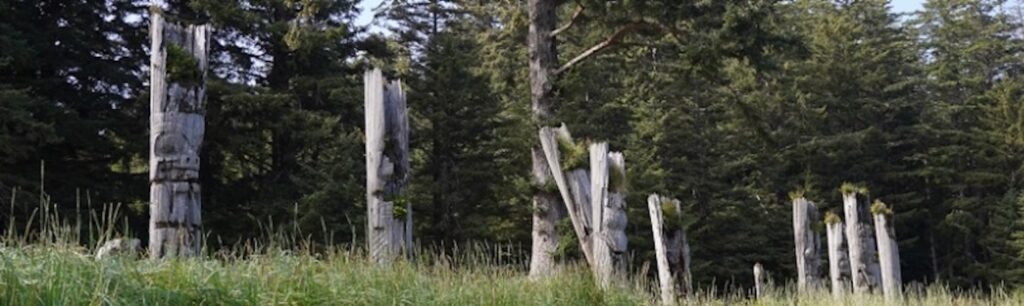
In 1787, a little over a decade after the arrival of the Spanish explorer Juan Pérez, British Captain George Dixon arrived at shores of the Haida Gwaii aboard his ship the Queen Charlotte to trade iron tools for sea otter pelts worth a fortune in the far east. Two years later, Captain Robert Gray and his senior officer John Kendrick arrived from Boston aboard the Lady Washington to seek their fortunes.
Although the Haida routinely traded with other coastal tribes, they had never met people like these who commanded enormous ships equipped with fearsome weapons. At first, the trading was amiable, but as time when on, the white traders grew more aggressive and openly disrespectful of the Haida. In the summer of 1791, Gray’s senior officer John Kendrick, now in command of the Lady Washington, seized and humiliated Haida chiefs, setting off decades of anger and violence that would continue well into the 1800s. As the influx of Europeans increased, Haida elders watched their world dramatically change and wondered what the future might hold for their people if it continued unabated.
Part of the answer appeared in 1829 from two unlikely messengers: Reverend Johnathon Smith Green from New England and the Haida medicine man, Kwanduhadgaa. Reverend Green told the Haida that their totem poles were “graven images” that angered God, and that God disliked their dancing, potlatches, and their way of burying their dead. This news astounded the Haida, who saw no reason those things should offend God.
But it planted the seeds of doubt.
The second message came from one of their own, the medicine man Kwanduhadgaa. While searching for a way to combat the new diseases that arrived with the Europeans, he received an ominous vision after a period of ritual cleansing and fasting. What he saw was destruction – entire Haida villages wiped out by God because of His dislike of totems and mortuary poles. In his vision, the few people that survived congregated at Massett and Skidegate on the northern island.
The warnings of the reverend and the medicine man echoed through the Haida society for decades until a new development occurred that set the stage for their predictions to become a reality: the discovery of gold.
In Raven’s Cry, there is a story about a Haida man who brought a deer he had shot to a Hudson’s Bay Company trader. The trader discovered it was with a “golden bullet” the hunter had made when he ran out of iron ammunition. Another story suggests the lust for gold started in March of 1851 when a Haida man sold a 27-troy-ounce nugget at Fort Victoria for 1,500 blankets.
As the gold rush progressed, new forms of confrontation between the Haida and the traders occurred. By now, the traders had begun to view the Haida less as a trading partner and more as an obstruction to taking what they wanted, which at this time was their gold. By 1858, amidst the gold rush, members of the northern indigenous communities had begun to congregate at Fort Victoria on the southern coast of Vancouver Island to work and trade with the settlers and new arrivals. The crowding of more than 2,000 indigenous people representing multiple tribes at the government-designated “Northern Encampment” just outside Victoria created a tense environment in which unresolved disputes were worsened by the presence of alcohol. Haida Chief Edinsa (later christened Albert Edward Edenshaw) viewed the behavior of his people and the violence amongst tribes with deep concern. What he didn’t know was that this crowded place would become ground zero for a deadly smallpox outbreak.
History books tell us that the smallpox epidemic that decimated the Haida and many other northern coastal indigenous people began when a passenger from San Francisco carrying the disease arrived in Victoria on March 12, 1862. The reality was the disease had been lurking in the coastal areas of North America since the late 1700s, awaiting its opportunity to explode, and the arrival of the San Francisco passenger lit the fuse.
Within a few months, the virus had raged through the Northern Encampment, and the occupants were forced by government officials to leave Victoria and return to their villages, a decision that guaranteed the spread of the disease. Vaccinations were available, but most were provided to the settlers or their immediate tribal neighbors near Victoria. The Haida suffered greatly when the disease arrived on their shores; within a year, the death toll was estimated to be 70 to 80 percent, reducing the population from tens of thousands before European contact to about 500. By 1900, most of the historic villages on the Haida Gwaii had been abandoned, with the survivors living primarily at Skidegate and Massett, as Kwanduhadgaa had prophesied. The outbreak of the disease instilled a fear in the Haida that set the stage for the arrival of the Changers.
The Changers: Rules, Regulations, Destruction
“Save some souls for the pope if you can, but bring home gold” was the common marching order given to Vasco Núñez de Balboa, John Cabot, Juan Ponce de León, Henry Hudson, Jacques Cartier, Hernando Cortés, Samuel de Champlain, Vasco de Gama, Ferdinand Magellan, Sir Francis Drake, Francisco Pizarro, Amerigo Vespucci, and scores of lesser-known explorers and adventurers sent across the oceans to find and take booty for their patrons.
Mark Dowie. The Haida Gwaii Lesson: A Strategic Playbook for Indigenous Sovereignty
One might assume the colonialism that subjugated the indigenous peoples of the Americas began with first contact in the late 1700s, but the marching orders were issued hundreds of years earlier in the form of a papal decree. On May 4, 1493, Pope Alexander VI issued a papal bull later called the “Doctrine of Discovery” (Doctrine) that stated Christian explorers could claim and take land previously unknown to themselves if it was ruled by non-Christians. Although the tenets of the Doctrine have been debated and challenged for hundreds of years, it continues to be used to justify colonialism, empire expansion, cultural suppression, and in some cases, genocide.
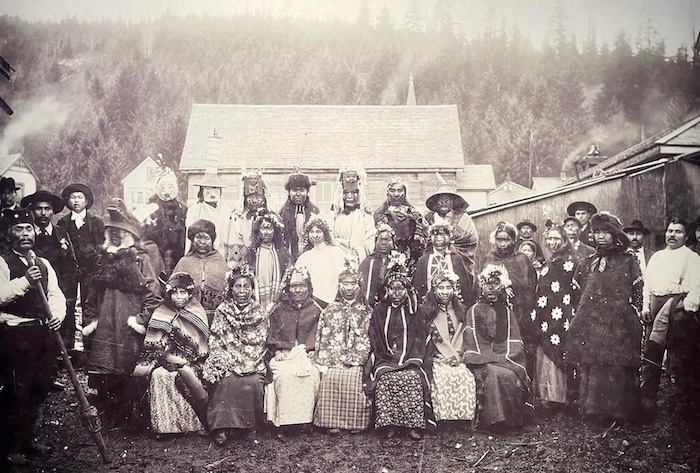
The Changers, in the form of missionaries and government officials, arrived on Haida Gwaii in the 1800s intent on making the Haida respectable citizens of the British Crown, and later the Canadian government. They were fully aware of the Doctrine but knew little to nothing about the Haida. As with the Takers, the effect of the Changers to Haida culture came slowly at first and were subtle. But before long, they began to erase all aspects of the Haida society. The effects on the Haida culture were as devastating as smallpox.
During my trip to the Haida Gwaii, I encountered an odd road name in old Massett: “Collision Avenue.” A second look confirmed that name was actually Collison, in honor of William Collison, the first missionary to live and work in the Haida Gwaii at the behest of Chief Edinsa/Albert Edward Edenshaw in 1878. He later wrote a book about his time there called “In the Wake of the War Canoe.” The full title of this book provides a glimpse of the way white visitors viewed the Haida and other coastal tribes at the time.
Chief Edinsa and William Collison were initially on good terms, and most of the population seemed to admire and respected him. Over time, he quietly but firmly diminished the power of the shaman and medicine men (smallpox was still lurking and Collison had access to vaccines) and became a powerful but somewhat troubling presence in the community. Although the Haida were receptive to the Christian message because they believed the example of Jesus was similar in many ways to their own spiritual worldview, the actions of Collison and others to alter and erase Haida culture disturbed tribal leaders. Chief Edinsa confided to his nephew Tahayghen/Charles Edenshaw that the old ways were disappearing, and there appeared to be no way to stop it.
After Collison was assigned to a new mainland post in 1879, his successor, Reverend Charles Harrison, began baptizing the Haida in 1884 and assigning English names: Gwai-gwun-thlin/Chief Edinsa became Albert Edward Edenshaw; his wife, Sun-Lak-Kwee-Kun became Amy Edenshaw. A Raven, she initially objected to taking her husband’s Eagle name, but was rebuffed by the reverend who did not understand Haida moieties. The chief’s nephew Tahayghen/Da-axiigang became Charles Edenshaw, and his wife chose the name Isabelle, after European nobility. She didn’t bother to protest that Haida tradition that did not allow her to take her husband’s Eagle name.
Throughout the latter part of the 19th century and well into the 20th, the Christian churches worked closely with the governments of Great Britain and Canada to carry out the pronouncements in the Doctrine on a large scale throughout the west coast of British Columbia. In 1884, the Canadian government declared the Haida Gwaii archipelago to be a reservation, denied Haida sovereignty over land they had occupied for thousands of years, and banned potlatch celebrations. Totem poles were torn down and used for firewood, and masks, songs, and traditional dress were forbidden. To ensure future generations would not resume old practices, residential schools sanctioned by the government and run by Catholic, Anglican, Methodist, and Presbyterian churches were created with the objective of “complete assimilation” of indigenous children into white society. In an article posted by the Harvard Divinity School, titled “Residential Schools of Canada” the authors revealed the true goals of church and state:
Indigenous peoples resisted the destruction of their way of life; they refused to convert to Christianity or assimilate into European culture. Canadian colonialists thought residential schools could change this. They had failed to destroy native ways of life in adults, so they tried to do so by separating children from their parents to stop indigenous culture, language, and religion from being passed on from parent to child. As Duncan Campbell Scott of the Bureau of Indian Affairs said in 1920: “Our object is to continue until there is not a single Indian in Canada that has not been absorbed.”
The results were devastating to the children, their parents, extended families, and future generations.
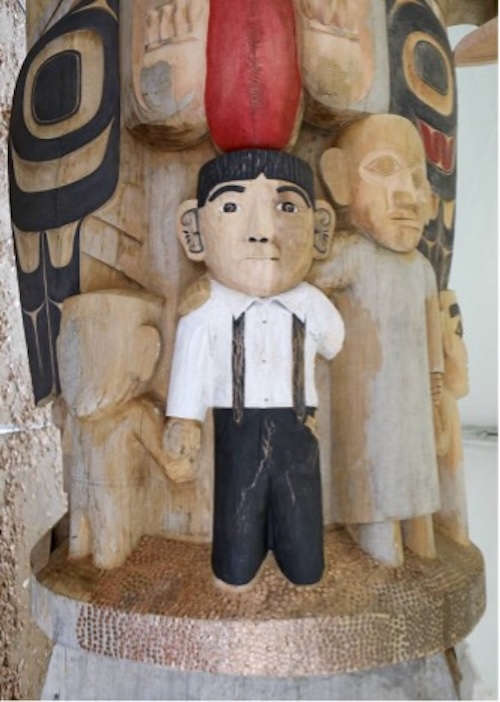
The first residential school in Canada opened in 1831, and by the late 1880s, they were endorsed and funded by the Canadian government. In 1920, the government formalized the funding and administrative process via the Indian Act, which made school attendance of treaty-status children between the age of 7 and 15 mandatory. The horrors the children endured cannot be overstated. Archival records from the Truth and Reconciliation Commission noted the schools were poorly constructed and overcrowded, with insufficient heating and ventilation and no way to isolate sick children from healthy ones. Substandard nutrition and lack of medical care greatly decreased the chance of survival from the diseases that were common at the time.
In 1907, after a visit to 35 residential schools in western Canada, Peter Bryce, the Indian Affairs chief medical officer, informed his superiors that the overall death rate of residential school students was 25 percent, with a 69 percent death rate at one school.
In a 2021 interview, Sphenia Jones, a residential school survivor from Haida Gwaii, described an experience that was tragically common among residential school students:
At the age of 11, Sphenia was put on a train that stopped frequently to pick up children. “There was a whole bunch of kids in there. They were stopping and picking up a bunch of kids… Some of them died on the way and they just threw them off the train.”
When Sphenia arrived at her destination, her hair was cut and she was assigned to work in the infirmary where she had a close-up view of the cruelty. “When I was working in the infirmary, I found this little girl — her name was Marjorie Victoria Stewart — and her head was bashed in, in the back. I brought breakfast up for her and I was calling her name and she wouldn’t move so I put the tray down. I remember putting the tray down and hugging her, trying to wake her up, shaking her. There was blood all over the pillow and I got scared so I went running down to talk to the principal about it and I told him to go to the infirmary.”
Sphenia later found out the little girl was hit in the head with a two by four for running in the hallway. “They strapped me. They told me never ever ever tell what I saw. I don’t know if they ever sent her home or buried her there. I never found out what happened with that.”
Sphenia described her experience as “Very scary… mainly because there were so many little kids that were younger than me there. Babies. That’s what I couldn’t get over.”
During the operation of Canadian residential schools, more than 150,000 indigenous children were taken from their homes to “Christianize and civilize” them. Many suffered sexual and psychological abuse and thousands never returned. The actual number of children who died may never be known, given the lack of accurate records and the large number of unmarked graves that have been discovered by investigators in the last decade alone. At present, approximately 4,000 deaths have been confirmed, but it’s considered to be only the tip of the iceberg. The residential school system has been compared to government-sanctioned torture of children by some, and cultural genocide by others, as noted below, and the survivors are reluctant to share their stories.
The Truth and Reconciliation Commission of Canada (TRC) called this a “systematic, government-sponsored attempt to destroy Aboriginal cultures and languages and to assimilate Aboriginal peoples so that they no longer existed as distinct peoples.” The TRC characterized this intent as “cultural genocide.”
Although most of the Canadian residential schools closed in the 1960s, the last federally funded one continued to operate until 1997. Its closure signified an end to an abhorrent institutional system that had been in operation for over 160 years.
On 11 June 2008 Prime Minister Stephen Harper stood in the House of Commons to offer on behalf of the Government of Canada, an apology to Indigenous peoples in Canada for the abuse, suffering, and generational and cultural dislocation that resulted from assimilative, government-sanctioned residential schools. The apology specifically addressed the assimilative practices of the government, the forced removal of children from their families, the abuse suffered by many of those children, and the resulting effects of the policies.
Between 1986 and 2016, additional apologies to indigenous people were provided by churches, the Canadian government, and the Royal Canadian Mounted Police:
1986: United Church of Canada
1991: Canadian Conference of Catholic Bishops
1991: The Missionary Oblates of Mary Immaculate
1993: Archbishop of Halifax
1993: Anglican Church of Canada
1994: Presbyterian Church in Canada
1998: United Church of Canada
2004: Royal Canadian Mounted Police
2008: Archbishop of Grouard-McLennan, Alta
2008: Government of Canada
2009: Bishop of Mackinzie-Fort Smith in Yellowknife
2014: Royal Canadian Mounted Police, Bob Paulson
2015: Government of Alberta
2016: Government of Ontario
For many, these formal apologies were an important part of moving forward, but real healing would require much more than an acknowledgement of wrongdoing by the Canadian government.
The Learners: Discovery, Preservation, Appropriation
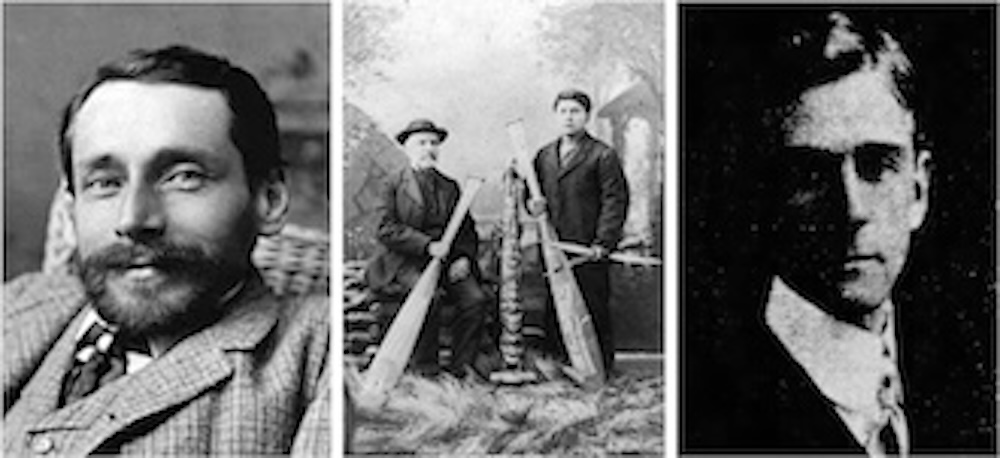
L-R: George Dawson, James Swan and Johnny Kit Elswa, and John Swanton
The third kind of people who found their way to Haida Gwaii, the Learners, were not there to take, though some of their actions facilitate the removal of Haida cultural artifacts (including the bones of their dead) from the islands to museums and galleries throughout the world. They were not there to change, but their presence led to both positive and negative consequences for the existing and future Haida generations. Though some significant mistakes were made that have yet to be corrected, the Learners did help preserve some aspects of the Haida culture that were nearly lost after decades of colonialism.
I have chosen three people that illustrate how the Learners played a role in revealing and documenting the complexity of the Haida culture and the genius of their art.
George Dawson
During the spring of 1878, a Canadian geologist and surveyor named George Mercer Dawson met Chief Edinsa/Albert Edward Edenshaw for the first time. Dawson was working for the Geological Survey of Canada and was tasked with mapping the shoreline of the Haida Gwaii and needed a guide. When the Chief returned from a seal hunting expedition, he found Dawson waiting for him on the shore. The book Raven’s Cry notes that each man was impressed with the other, realizing they both represented “superior nations.”
In working with Chief Edinsa, Dawson was “…repeatedly astounded by his pilot’s intimate knowledge of every reef, cove, current and tide rip around the Haida Gwaii. And the Chief knew every village, every custom and legend; he knew where every bird nested, every fish swam, and where every devilfish may be lurking. He read the sky like a book, the sea like a marine chart. His knowledge was truly stupendous.”
The Chief, in turn, saw something special in this new Iron Man. “He wasn’t greedy like the traders. He wasn’t rushing to change everything, like the missionaries. He was more like a native person; he had time and patience to look and to listen. He didn’t arrive knowing everything; he came to learn something, to learn from a native person.”
George Dawson made the most of his time on the Haida Gwaii. With Chief Edinsa’s guidance, he studied literally everything. His work described historical accounts of the archipelago, observations of the geology, descriptions of how the Haida dressed, what they ate, how they danced, where and how they lived, and their social customs and structure. He studied the marine invertebrates, collected plants, made meteorological observations, and even attempted to document Haida vocabulary.
The art he encountered confirmed his initial impression that he was indeed in the presence of a superior culture. His report contained some of the 63 photographic plates he created during his time in the Haida Gwaii, which he described as “…points of geological and picturesque interest, and also the peculiar carvings and architectural devices of the Haidas.” One phrase in his report about the state of some of the totem poles and art caught the attention of scientists, anthropologists, and ethnologists already concerned about the Haida Gwaii:
“These had not before been photographed, and owing to the rapid progress of decay it will be impossible to obtain satisfactory illustrations of them in a few years time.”
James Swan
Pioneer/historian James Gilcrist Swan was a complicated, curious, and creative man. During his life, he was an anthropologist, political advisor, artist, schoolteacher, and endless promoter of Port Townsend, Washington, where he spent his final days. Swan traveled far and wide along the northwest coast, mostly on foot or by canoe, where he absorbed, appreciated, and documented indigenous culture.
Swan arrived on the Pacific Coast in 1852 from Boston, Massachusetts. Although most of his business ventures were failures and he was often financially challenged, he excelled as a self-taught ethnologist, and his passion was the indigenous tribes of the Northwest Coast. He was one of the few white settlers who took an interest in indigenous art, language, and traditions, and lived for a time with the Makah at Neah Bay, Washington, as a deputy customs collector and schoolteacher.
During his time with the Makah, he recorded in his diaries observations on their lives and art, published stories about their culture in magazine articles and books, and sent examples of Makah art and household items to the Smithsonian Institution, who later hired him in 1875 to provide examples of indigenous cultures from coastal British Columbia and southeastern Alaska to exhibit at the 1876 Philadelphia Centennial Exposition.
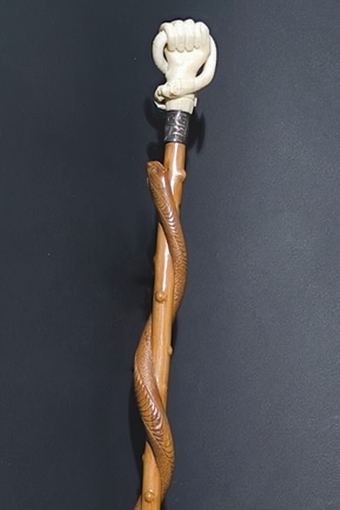
With financial support from the Smithsonian Institution, he finally made it to Haida Gwaii in 1883, accompanied by Johnny Kit Elswa, a young Haida artist he had befriended in Port Townsend. Soon after his arrival, he met Chief Edinsa/Albert Edward Edenshaw, and his artistic nephew Tahayghen/Charles Edenshaw. At the age of 65, Swan even got a look at the mysterious west coast of Haida Gwaii from the Chief’s canoe, an accomplishment that even George Dawson couldn’t claim. He returned home with two canes carved by Tahayghen that he had purchased for $10 each. One of them resides in the Port Townsend museum I visited in the 1980s, obtained as part of Swan’s personal collection. That’s the one that planted the idea that became my trip to the Haida Gwaii 40 years later. The other is in the Smithsonian Institution.
When James Swan died on May 16, 1900, he left behind a collection of private diaries he began in 1859. In all, he wrote 2,500,000 words and created hundreds of sketches that provide an important glimpse into the lives of indigenous people of the Northwest Coast.
John Swanton
In 1900, another curious visitor arrived on the shores of Haida Gwaii: a young man named John Reed Swanton. A recent graduate from Harvard, he began his first job with the Smithsonian Institution under the direction of the anthropologist Franz Boaz. His marching orders were clear: study all aspects of the Haida culture. The Haida Gwaii he encountered in 1900 was a shadow of what had existed before smallpox decimated the population, and still reeling on the brink of extinction.
Swanton soon realized that transcribing the myths and stories of the Haida elders was the most important thing he could do with his time. A young Haida named Henry Moody served as Swanton’s translator and guide. Swanton began his work with Moody’s father, then listened and learned at the feet of Ghandle of Qayah Llaanas/Walter McGregor and Skaay of Qquuna Quighawaay/John Sky. In the early 1900s, Ghandle and Skaay were the last living keepers of the old stories that went back to the beginning of Haida time.
The process for committing the stories to paper was straightforward but time consuming, for Swanton believed the stories should be recorded in the original Haida language, not paraphrased English, which was common at the time. From the fall of 1900 to the summer of 1901, Swanton and Moody listened to the stories of Ghandle and Skaay for most of each day. As an elder began his story, Moody would repeat a few sentences, and Swanton would transcribe the words using a phonetic alphabet developed by Franz Boaz. This allowed him to capture not only the specific vocabulary, but also the syntax and artistic choices of the storyteller. In this way, Swanton accumulated 40,000 lines of text that told the story of the Haida people from the perspective of two of their best storytellers.
In the intervening years after he returned to the Smithsonian, Swanton hardly made a dent in translating the Haida stories into English. In 1942, his manuscripts were transferred to the American Philosophical Society where they quietly awaited the arrival of Robert Bringhurst, a Canadian poet, typographer, and author, who began the monumental work of finishing the translations. While his books have made the Haida stories and myths accessible to a wider audience, he has received both acclaim and criticism for his work, which was published without consultation or permission from Haida knowledge-keepers.
The Tipping Point Arrives
Part 3 of this story will focus on the actions of the Canadian government that led the Haida to formally seek something they had never relinquished: aboriginal sovereignty over the Haida Gwaii.
The 20th century brought new challenges to the Haida and mixed signals from the Canadian government. The 1951 Amendments to the Indian Act brought them the right to vote without giving up treaty rights, but also the right of the Canadian government to exert authority over indigenous child welfare, creating another round of child separation. The Haida were stilled viewed as second-class citizens and relegated to a reservation within their own homeland. The government also issued “tree farm licenses” that enabled mainland corporations to harvest large amounts of the Haida Gwaii timber resources without consultation, permission, or compensation, leading to a “War in the Woods” in the mid-1980s.
These and other government actions led the Haida to begin a long journey to indigenous sovereignty that has become a roadmap for other indigenous cultures throughout the world who are struggling to regain control of their homelands and their futures. In addition, the ecological and cultural destruction caused by clearcut logging led to an ecosystem management approach driven by Haida ethics and values that is studied by conservation biologists as a model of sustainability that can be adapted and used throughout the world.
Information Sources
1770s Pacific Northwest Smallpox Epidemic, Wikipedia
1862 Pacific Northwest Smallpox Epidemic, Wikipedia.
A Contested Doctrine of Discovery, Albert Russell Thompson Jr., September 7, 2021.
A Story as Sharp as a Knife, The Classical Haida Mythtellers and Their World, Robert Bringhurst, Douglas & McIntyre, 1999.
A Timeline of Residential Schools, the Truth and Reconciliation Commission, CBC News, March 25, 2014.
Aboriginal History, Haida Nation, Canadahistory.com
Being in Being, The Collected Works of a Master Haida Storyteller, Skaay of the Uquuna Qiighawaay, 2001 and 2003.
Bringing Natural History to the People: Three Pioneers of the Pacific Northwest Frontier, Michael Arthur Weiss, Scholars’ Bank, University of Oregon, 1989.
Canadian Residential Schools: A Timeline of Apologies, CTV News, Jennifer Ferreira, December 09, 2021.
Canada’s Residential Schools Were a Horror, Ian Mosby and Erin Millions, Scientific American, August 1, 2021.
Canadian Indian Residential School System, Wikipedia.
Center for the Study of the Pacific Northwest: II. Indians and Europeans on the Northwest Coast: Historical Context, Washington.edu.
Chief Albert Edward Edenshaw, Authority Records, Museum of Anthropology, University of British Columbia.
Christian Missions on Haida Gwaii, 1829-1897, Awaahl.
Contributions to the Ethnology of the Haida, Memoirs of the AMNH ; [v. 8, pt. 1]; Publications of the Jesup North Pacific Expedition ; v. 5, pt. 1, John Reed Swanson, American Museum of Natural History, 1905.
Cultural Impacts – Banning of the Potlatch.
Discovery Doctrine, Wikipedia.
Disease Epidemics among Indians, 1770s-1850s, Robert Boyd, Oregon Encylopedia.
During My Time, Florence Edenshaw Davidson, A Haida Woman, Margaret B. Blackman, University of Washington Press, 1982.
Eda’nsa, Dictionary of Canadian Biography.
Final Report of the Truth and Reconciliation Commission of Canada, Prime Minister of Canada.
Geological survey of Canada. Report on the Queen Charlotte Islands. 1878, Dawson, George Mercer, 1849-1901, The University of British Columbia.
George Mercer Dawson, Wikipedia.
Haida, Canada History, Canadahistory.com
Haida Master Carver James Hart Tells the Story of Indian Residential Schools in Reconciliation Totem Pole, Amanda Siebert, March 31, 2017, Straight.com.
Haida Texts and Myths, Skidegate Dialect, John Swanton, 1905.
History of Smallpox, CDC (Center for Disease Control), October 23, 2024.
How Many Native Americans Were Killed During Colonization?, The Collector.
‘I Am Sorry’ — A Reflection on Pope Francis’s Apology on Residential Schools, The Conversation, Jonathon Hamilton-Diablo
Indian Residential Schools, Indian Residential School History and Dialogue Centre, The University of British Columbia.
In the Wake of the War Canoe: A Stirring Record of Forty Years’ Successful Labour, Peril & Adventure Amongst the Savage Indian Tribes of the Pacific Coast, and the Piratical Head-hunting Haidas of the Queen Charlotte Islands, B.C., William Henry Collison, 1915.
Islands at the Boundary of the World: Changing Representations of Haida Gwaii, 1774-2001, Joel Barry Martineau, The University of British Columbia Open Connections, 2002.
Jesup North Pacific Expedition, Wikipedia.
John R. Swanton, Wikipedia.
Nine Visits to the Mythworld Told by Ghandl of the Wayahl Llaanas, Douglas and McIntyre, 2001 and 2003.
Part One: Life at Residential School, National Centre for Truth and Reconciliation, University of Manitoba.
Punished and Hit for Speaking Her Language, a B.C. Residential School Survivor is Not Staying Silent, Amy Judd, Global News, June 25, 2021.
Raven’s Cry, Christine Harris with Illustrations by Bill Reid, McClelland and Stewart Limited, Toronto and Montreal, 1966.
Residential School History, The History of Residential Schools, National Centre for Truth and Reconciliation, University of Manitoba.
Residential Schools in Canada, Religion and Public Life, Harvard University
John Swanton, ABC Bookworld.
Residential Schools in Canada, J.R. Miller, The Canadian Encylopedia, January 11, 2024.
Report on the Queen Charlotte Islands, 1878, George Dawson, BC Historical Books, University of British Columbia Open Library.
Samuel Hancock Witnesses Smallpox Among the Makah, 1852-53, Northwest Coast Archaeology, February 20, 2010.
Smallpox and the Native American, Kristine B. Patterson and Thomas Runge, Science Direct, Volume 323, Issue 4, April 2002, Pages 216-222.
Smallpox Caused Devastation Among Northwest Tribes Including Eastern Washington Natives, The Spokesman-Review, October 27, 2022.
Solomon Wilson interview #1, General reminiscences of his life and he talks about a smallpox epidemic before he was born, University of Regina, 1969.
St. Michael’s (Alert Bay), National Centre for Truth and Reconciliation, University of Manitoba.
Swan, James G. (1818-1900), HistoryLink.
The 1862 Smallpox Epidemic, Awaahl.
The Epic Art of the Haida Mythtellers, By Matthew Spellberg, Los Angeles Review of Books, October 10, 2013.
The Extinct Caribou of Haida Gwaii, Grant Keddie, September 22, 2024.
The Horror of St. Michaels Residential School, Canadian Roadstories, Hans Tammemagi, January 5, 2018.
The Smallpox War Against the Haida, BC Studies, The British Columbia Quarterly, Tom Swankey, Review by Frederick White, August 13, 2024.
The Victoria Smallpox Epidemic of 1862, Grant Kedde, February 16, 2023.
“To Christianize and Civilize,” Settler Motives and Residential Schools, Transcribed and Curated by Chris Willmore.
Translation of Haida Narratives into English, Tiffany Templeton, Circuit, Le Magazine D’Information Des Langagiers, Number 39, 2018.
Truth and Reconciliation Commission of Canada, Wiikipedia.
Vanishing the Haida: George Dawson’s Ethnographic Vision and the Making of Settler Space on the Queen Charlotte Islands in the Late Nineteenth Century, Jason Grek-Martin, Canadian Geographies, Wiley Online Library, May 15, 2017.
Why So Many Children Died at Indian Residential Schools, Tristan Hopper, National Post, May 29, 2021.
William Collison, Wikipedia.

0 Comments